
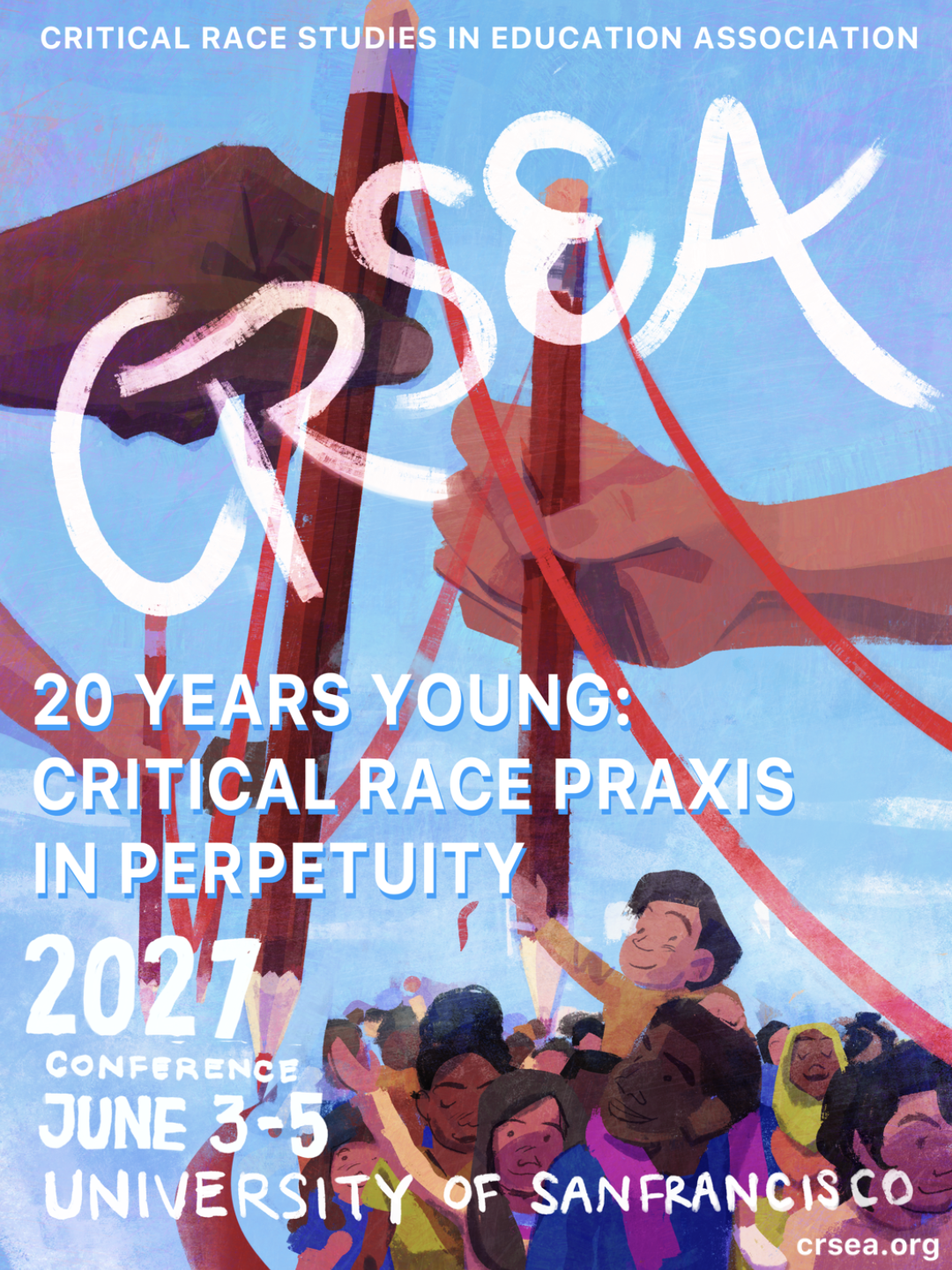
call for proposals 2027
We invite proposals that critically engage with this year’s theme:
20 Years Young: Critical Race Praxis in Perpetuity
📅 June 3rd - 5th
📍University of San Francisco
2027 Conference Proposal Timeline

Submission Opens
October 1st, 2026
Submission closes
November 15th, 2026| 11:59 PM (CST)
Not. of Acceptance
January 8th, 2027
12 years after Ladson-Billings and Tate (1995) released their seminal publication introducing Critical Race Theory to the field of education, Drs. Thea Berry, Marvin Lynn, and David Stovall (with contributions from Ann Aviles, Denise Taliaferro Baszile, and Tara Yosso) hosted the first convening for what would become Critical Race Studies in Education Association (CRSEA). It was their intent to “put folks in the same room who were using CRT in their research and praxis to figure out how to support each other” (Stovall, personal communication, 2026). Over the past two decades, CRSEA has remained a vital site for generating critical analyses of racism in education while also nurturing the relationships, coalitions, and forms of collective (re)anecessary to advance educational justice.
20 years after the first CRSEA conference in Chicago, we will gather June 3-5, 2027, at the University of San Francisco, to both remember our roots and reimagine the next 20 years of critical race studies in the field of education. The 2027 theme, 20 years young: Critical Race Praxis in Perpetuity, is an invitation for researchers, community organizers, educators, and students to share, to connect, and to construct the coalitions necessary to build the sorts of worlds we collectively imagine together. The conference is also a space for us to move against what Yamamoto (1997) referred to as the disjunctures and disassociations that exist between theorizations of race and the practice of advancing racial justice. As such, this year’s conference invites proposals for presentations, workshops, and assemblies that build our critical race conceptualizations and that provide examples and models of work taking place through Critical Race Theory to advance justice in education.

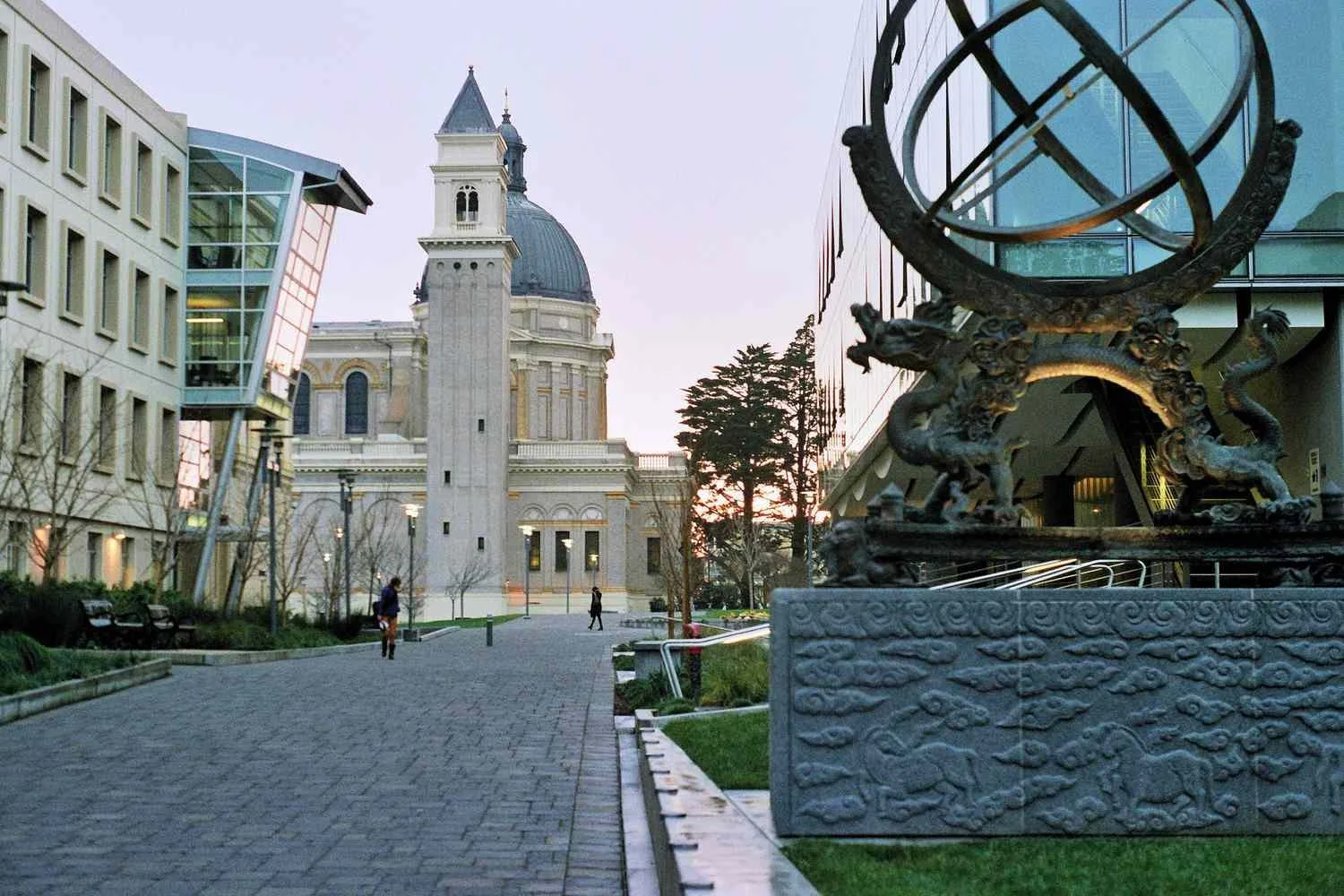
2027
San Francisco, CA
The twentieth convening of CRSEA asks participants to consider several interrelated questions:
What (re)conceptualizations of Critical Race Praxis are most urgently required in the present historical moment?
How might critical race scholars deepen relationships between theory, organizing, teaching, and policy intervention?
What lessons have emerged from the past two decades of critical race scholarship in education, and what new conceptual, methodological, and political possibilities are needed for the decades ahead?
-
The 2027 CRSEA Conference theme centers on Critical Race Praxis. While some attendees may be deeply familiar with this framework and others encountering it for the first time, we invite all participants to engage Critical Race Praxis as an evolving conversation about the relationship between Critical Race Theory and the pursuit of racial justice in the world.
Disturbed by Critical Race Theory’s inability to “explore the difficult dynamics and racialized settings of coalition formation and action” (Yamamoto and Su, 2002, p. 386), Legal Scholar Eric Yamamoto introduced Critical Race Praxis, a conceptualization of Critical Race Theory that attempted to unite race scholars and activists in their contributions to progressive social-justice movements, like the ones he and his law students were engaged in alongside garment workers in Los Angeles in the 1990s. For Yamamoto, Critical Race Praxis combined “critical, pragmatic, socio-legal analysis with political lawyering and community organizing to practice justice”. Yamamoto's intervention challenged scholars not merely to theorize racial subordination but to situate knowledge production within ongoing struggles for racial justice, thereby positioning Critical Race Praxis as both a conceptual and political project.
In this sense, Critical Race Praxis encourages race scholars—practicing and emergent—to “explore the experiences of racial communities and locating theory development and application within their antisubordination struggles” (Yamamoto, 1997). Yamamoto’s four starting points of Critical Race Praxis—the conceptual, the performative, the material, and the reflexive—offer critical race scholars in all disciplines a frame to “spend less time with abstract theorizing and more time in communities experiencing injustice” (Wilson et al., 2024). Since Yamamoto’s introduction of Critical Race Praxis to the field of legal studies, education scholars have taken up Critical Race Praxis in their work to illuminate the endemic nature of racism and to advance racial justice projects in communities across the world (Annamma et al., 2022; Jayakumar & Adamian, 2015; Kohli, 2025; McCay, 2010; McGee & Stovall, 2015; Stovall, 2004, 2005; Stovall et al., 2009; Wilson et al., 2024).
Inspired by Yamamoto's vision and the generations of scholars, educators, organizers, and youth who have extended it, CRSEA 2027 seeks to create a space for critical reflection, collective dreaming, and strategic action. Together we will examine the conditions shaping our present, learn from ongoing struggles for educational justice, and imagine new possibilities for socially transformative futures. We welcome proposals that explore how critical race scholarship informs and is informed by educational practice, community engagement, organizing, policy advocacy, artistic expression, youth leadership, coalition building, and additional efforts to advance educational justice. We are particularly interested in work that grapples with the opportunities, tensions, contradictions, and possibilities that emerge when Critical Race Theory is taken up in the everyday work of creating more just educational worlds.
-
The Bay Area is particularly suited for the 20th convening of the CRSEA conference. It’s home to many critical race scholars, and it’s been the site of the solidarity work that Critical Race Praxis advocates for and memorializes. From the birth of social movement organizations like the Black Panther Party, to the long-standing P-20 ethnic studies movement, to current struggles to protect all peoples and all lands, the Bay Area has roadmaps, stories, ideas, and practices that we can bridge to and through the context(s) of our homeplaces.
2027 Conference Proposal Types
Whether your work examines praxis, documents it, theorizes it, critiques it, or embodies it, we invite you to join us in reflecting on what Critical Race Praxis has meant over the last twenty years and what it might become in the decades ahead. In efforts to create space for the sorts of coalition building that Yamamoto and additional critical race scholars call for, the 2027 CRSEA conference will accept several types of proposals:
-
These unpublished papers should present works in progress that address important issues related to Critical Race Theory while also exemplifying cases and models of education justice projects throughout the world. Individual papers will be grouped with others to form concurrent sessions. Each presenting paper can expect to present for 10-12 minutes. Proposals should include a title, presenters, an abstract of no more than 150 words, and a summary of 500 words or less (exclusive of references) detailing the paper’s conceptual and methodological underpinnings, findings, and implications.
-
Symposium group 3-5 unpublished papers across a major theme, presenting works in progress. Each paper should present important issues related to Critical Race Theory while also exemplifying cases and models of education justice projects throughout the world. Symposium presentations will have an entire concurrent block to present (50-60 minutes). Proposals should include a title, presenters, an abstract of no more than 150 words, and a summary of 1500 words or less (exclusive of references) detailing the overall session’s focus and each paper’s conceptual and methodological underpinnings, findings, and implications. Symposium proposals should also include identified session facilitators–one session chair and one session discussant (chairs and discussants can be presenters).
-
These interactive and dialogic sessions should present works related to Critical Race Theory and cases of education projects in ways that are participatory and dialogic. They avoid a formal presentation of information and take up engaging methods to involve participants as active participants in the session content. Symposium presentations will have an entire concurrent block to present. Workshop presentations will have an entire concurrent block to present (50-60 minutes). Proposals should include a title, presenters, an abstract of no more than 150 words, and a summary of 1500 words or less (exclusive of references) detailing the workshop’s focus and a tentative agenda.
-
Have an idea, a concept, situation, etc. you want to share with others? Roundtables will offer space for works and ideas in progress. Presenters will be organized at tables by theme, facilitated by critical race scholars that include time allotted to share and for discussion. Proposals should include a title, presenters, an abstract of no more than 150 words, and a summary of 500 words or less (exclusive of references) detailing the roundtable idea.
-
Are you organizing around a critical race issue or aspiration? Want space at the conference to bring people together for national action? Drawing inspiration from the assemblies of the Social Forums and Free Minds Free People, assemblies will bring together conference attendees to organize and mobilize around regional and national campaigns/actions. Campaigns can be ideas or active. Ultimately, they aim to provide CRSEA conference attendees space to organize around issues. Assemblies move the CRSEA community into sustained action beyond the confines of the conference. Proposals should include a title, presenters, an abstract of no more than 150 words, and a summary of 1000 words or less (exclusive of references) detailing the assembly’s focus and agenda.
If you have further questions on proposal submissions please email Programming Chairs, Dr. Hawkins and Dr. Osly J Flores at: crseaprogramming@gmail.com
Get In Touch
Dr. Hawkins
Dr. Osly J Flores

references
-
Annamma, S. A., Ferri, B. A., & Connor, D. J. (2022). Introduction to the Special Issue-Imagining Possible Futures: Disability Critical Race Theory as a Lever for Praxis in Education. Teachers College Record: The Voice of Scholarship in Education, 124(7), 3-16. https://doi.org/10.1177/01614681221111427
Jayakumar, U. M., & Adamian, A. S. (2015). Toward A Critical Race Praxis for Educational Research: Lessons from Affirmative Action and Social Science Advocacy. Journal Committed to Social Change on Race and Ethnicity (JCSCORE), 1(1), 22–58. https://www.jstor.org/stable/48644850
Kohli, R. (2025). Research as Healing: Reflections of a Teacher Educator of Color on Critical Race Praxis. Qualitative Inquiry, 31(7), 738-747. https://doi.org/10.1177/10778004241269995
Ladson-Billings, G., & Tate, W. F. (1995). Toward a Critical Race Theory of Education. Teachers College Record: The Voice of Scholarship in Education, 97(1), 47-68. https://doi.org/10.1177/016146819509700104
McKay, C. L. (2010). Community Education and Critical Race Praxis: The Power of Voice. The Journal of Educational Foundations, 24(1), 25-38. https://www.proquest.com/scholarly-journals/community-education-critical-race-praxis-power/docview/205234086/se-2
McGee, E.O. and Stovall, D. (2015), Reimagining Critical Race Theory in Education: Mental Health, Healing, and the Pathway to Liberatory Praxis. Educ Theory, 65: 491-511. https://doi.org/10.1111/edth.12129
Stovall, D. (2004). School leader as negotiator: Critical race theory, praxis, and the creation of productive space. Multicultural Education, 12(2), 8-12. https://files.eric.ed.gov/fulltext/EJ781916.pdf
Stovall, D. (2005). Chapter nine: Critical race theory as educational protest: Power and praxis. Counterpoints, 237, 197-211. http://www.jstor.org/stable/42978681
Stovall, D., Lynn, M., Danley, L., & Martin, D. (2009). Critical race praxis in education. Race Ethnicity and Education, 12(2), 131–132. https://doi.org/10.1080/13613320902995418
Wilson, A., Dávila, E., Gamboa-Turner, V., Shony, A., & Stovall, D. (2024). Why we need Critical Race Theory: moving toward Critical Race Praxis in P-20 education. Equality, Diversity and Inclusion, 43(3), 410-424. https://doi.org/10.1108/EDI-01-2023-0017
Yamamoto, E. K. (1997). Critical race praxis: Race theory and political lawyering practice in post-civil rights America. Michigan Law Review, 95(4), 821-900
Yamamoto, E. K. and Su, J. A. (2002). Critical coalitions: Theory and praxis (2002). Available at SSRN: http://dx.doi.org/10.2139/ssrn.1979945